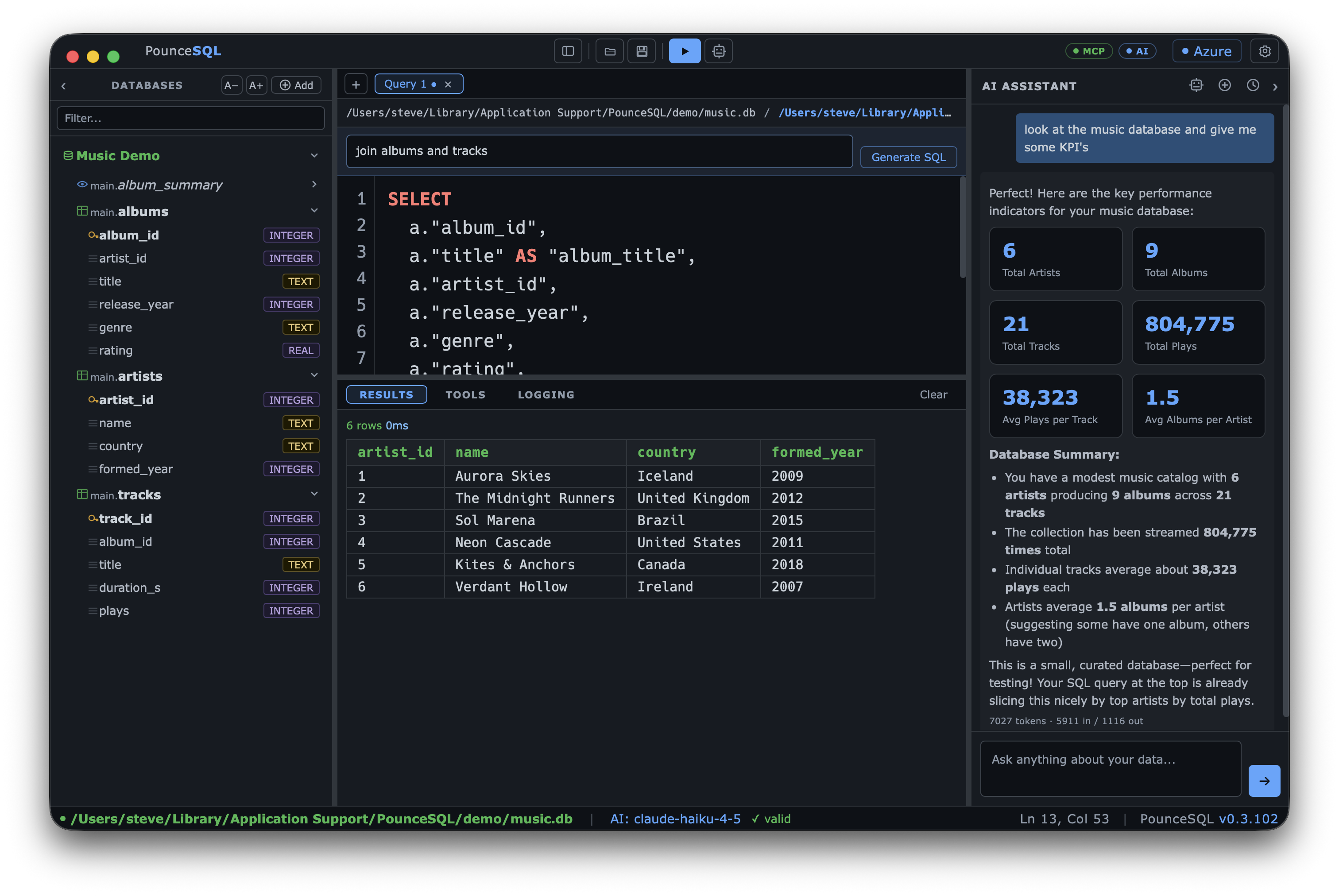
A fast, native macOS client for Azure SQL, SQL Server, PostgreSQL and SQLite — with an AI assistant that doesn't just write queries, it diagrams your schema and charts your results.
brew install --cask senzalldev/tap/pouncesqlShips with a built-in demo database — open it and start querying, no server or login required.
erDiagram
ARTISTS ||--o{ ALBUMS : "records"
ALBUMS ||--o{ TRACKS : "contains"
ARTISTS { int id PK; text name; text country }
ALBUMS { int id PK; int artist_id FK; text title; int year }
TRACKS { int id PK; int album_id FK; text name; int seconds }
Browse subscriptions, servers and databases with your az login session — no passwords stored.
2017–2025+, local or domain-joined. SQL login, Windows/NTLM, or passwordless Kerberos SSO.
Connect over LAN, VPN or Tailscale. Pin a whole server and browse every database it hosts.
Open any .db file — no server, no login. Just pick the file and start querying.
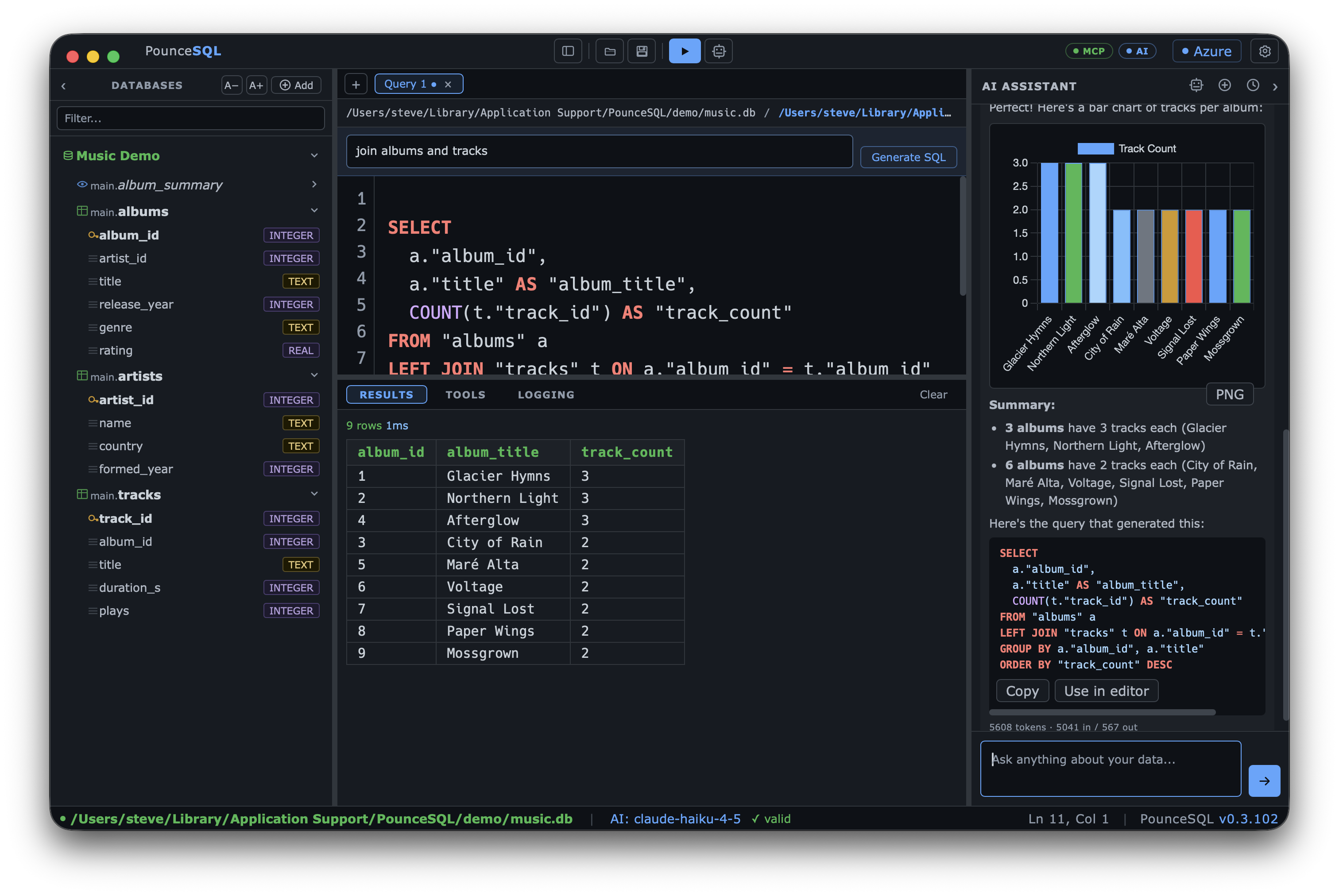
The built-in assistant runs read-only queries against your connection, then renders the answer. Everything below is live in your browser — the same output PounceSQL renders in the app.
Here's the entity-relationship diagram — one artist has many albums, each album has many tracks:
erDiagram
ARTISTS ||--o{ ALBUMS : records
ALBUMS ||--o{ TRACKS : contains
ALBUMS ||--o| ALBUM_SUMMARY : summarizes
I ran SELECT title, COUNT(*) … and charted it:
Releases per genre across decades:
Snapshot of the catalog:
Engine-correct SQL with a one-click Use in editor, plus math in LaTeX-style notation:
SELECT ar.name, COUNT(t.id) AS tracks FROM artists ar JOIN albums al ON al.artist_id = ar.id JOIN tracks t ON t.album_id = al.id GROUP BY ar.name ORDER BY tracks DESC;
Also renders Markdown tables, code, and LaTeX (e.g. window functions).
Diagrams use Mermaid, charts use Chart.js — both rendered inside the app, sanitized, and exportable as PNG.
Pick a provider per your policy — cloud, enterprise gateway, or fully local — and switch models from a dropdown right in the chat header. Each provider remembers its own endpoint, model and key.
Direct API key. Native tool-calling for both — GPT and Claude can inspect your schema and run read-only queries. Choose Sonnet, Haiku, Opus, GPT-4o and more.
Point at http://host:11434 (localhost, LAN, or Tailscale). Your data never leaves your machine — ideal for sensitive/PHI work. Load the model list from the server.
OAuth2 gateways with a discovery endpoint. PounceSQL routes each model by its native format (OpenAI or Anthropic), shows cost per model, and a PHI-cleared badge from discovery.
Pin a server, expand it like a tree — every database, schema, table and column. Filter across databases; right-click to preview, count, or generate a query.
Syntax highlighting, table/column-aware autocomplete and a live syntax checker, tuned to the connected engine (T-SQL, Postgres, SQLite). Run the whole editor or just the selection.
Full Markdown, syntax-highlighted code with Copy / Use-in-editor, Mermaid diagrams, Chart.js charts, heatmaps, KPI cards, sortable result grids with CSV/JSON export, and LaTeX.
Your last 50 conversations are saved automatically — browse, reload, delete, export a chat as Markdown, or save any diagram/chart as PNG.
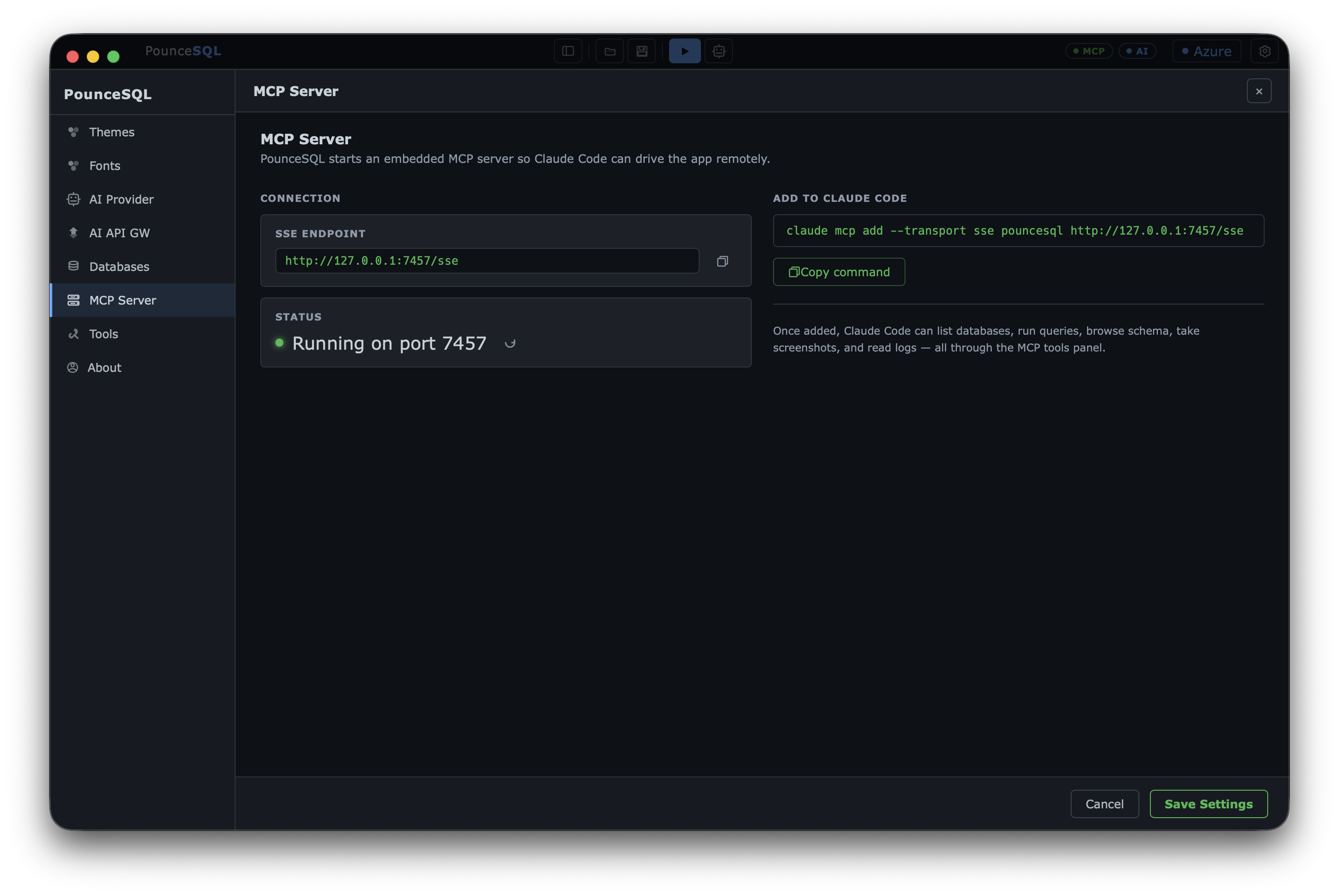
A local Model Context Protocol server lets Claude Code and other agents drive PounceSQL — list databases, run queries, configure the AI — and you watch it happen live.
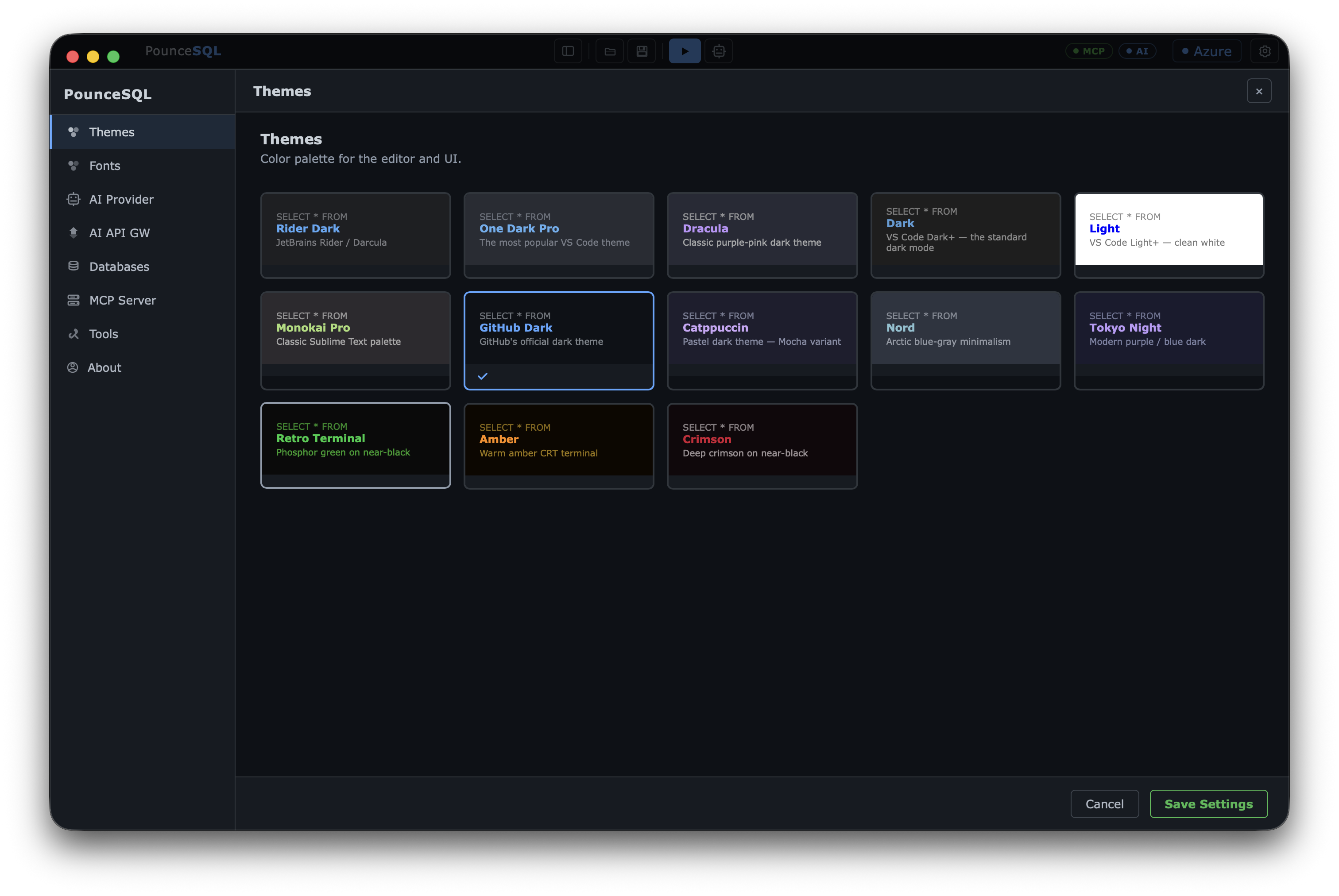
A dozen editor themes, separate fonts for interface and editor, independent size control for editor, tree, results and status bar, and a collapsible sidebar for more room.
Free, native, and notarized for macOS 13+ (Apple Silicon).
brew install --cask senzalldev/tap/pouncesql
Recommended — updates with brew upgrade.
Requires the Azure CLI for Azure SQL (brew install azure-cli, then az login).
⚠ Under active development, provided “as is” without warranty. Please test against a non-production database before using it against anything you care about. The AI assistant and MCP tools are read-only by default.